34,000+
Tracked objects
Catalogued debris and operational spacecraft in Earth orbit
Orbital recovery systems
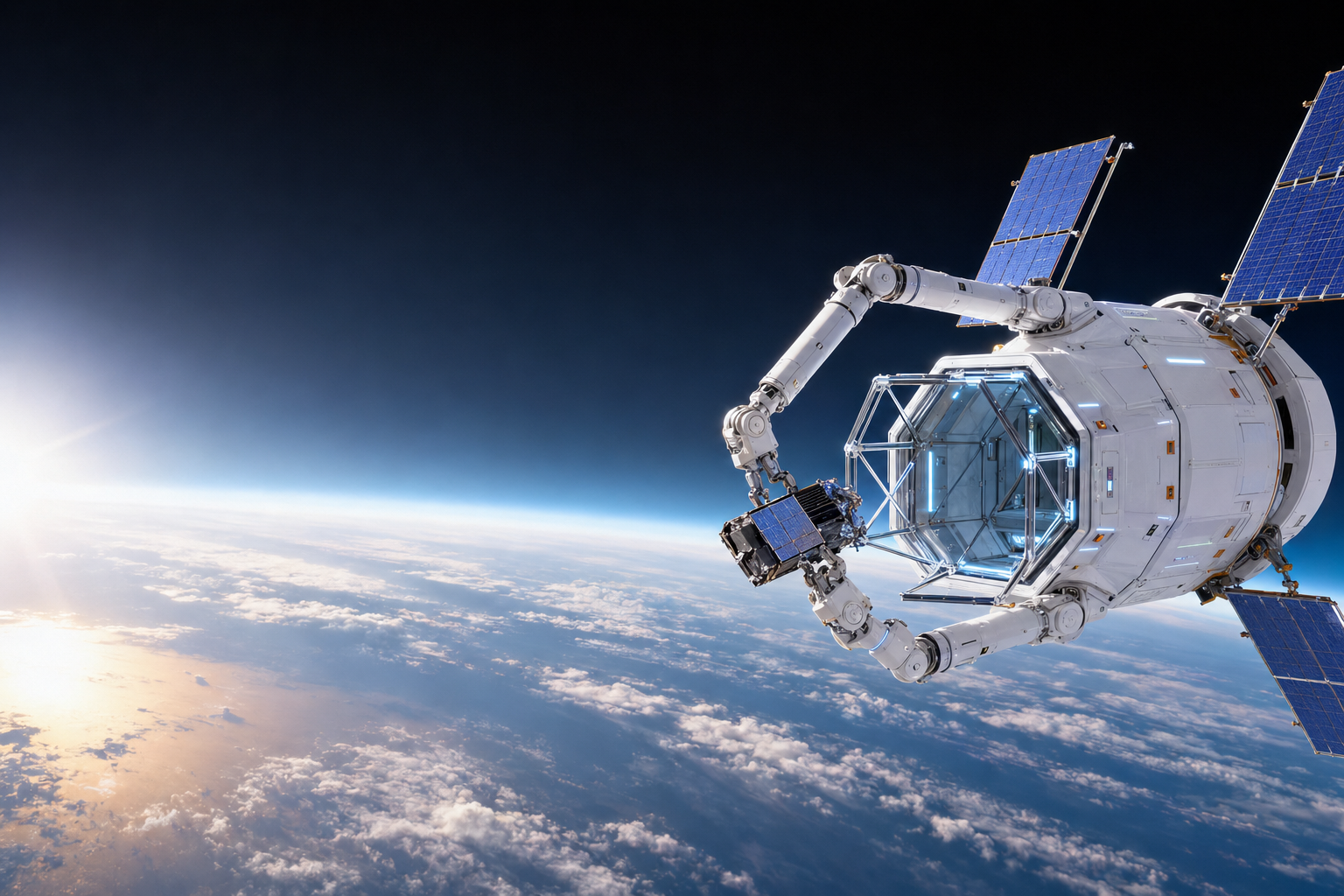
TVK Orbital is developing autonomous systems to detect, capture, separate and recover space debris—transforming orbital risk into resilient infrastructure for satellite operators, agencies and the global space economy.
34,000+
Catalogued debris and operational spacecraft in Earth orbit
1M+
Sub-centimetre debris that still poses collision risk
LEO
Low Earth orbit where congestion is accelerating fastest
24/7
Autonomous systems designed for continuous orbital operations
Our mission
The orbital environment is becoming critical infrastructure. Every inactive object adds uncertainty to communications, navigation, Earth observation and national security systems that societies rely on every day.
We are building a practical recovery layer for space—one that can reduce collision risk today and enable a more circular orbital economy tomorrow through inspection, sorting, removal and future in-orbit resource use.
Why it matters
As launch cadence accelerates and mega-constellations expand, the cost of inaction rises for every operator sharing crowded orbital lanes.
Even small debris fragments can disable active spacecraft. Removing high-risk objects reduces long-term cascade probability in valuable orbital shells.
Satellite operators need predictable orbits. Recovery missions help protect revenue services, science payloads and sovereign capabilities.
Agencies worldwide are tightening debris mitigation rules. Proactive recovery capabilities support compliance and responsible space operations.
Recovered materials and inspected components can support future in-orbit manufacturing, extending asset life beyond single-use disposal.
The recovery loop
Map objects, assess risk and prioritize recoverable targets using orbital intelligence and mission-ready sequencing.
Plan precise, autonomous proximity operations in dynamic orbits—including tumbling and non-cooperative targets.
Secure unprepared objects with adaptable capture systems designed around the debris, not a single mission profile.
Prepare recovered material for responsible de-orbit, inspection, sorting or future in-orbit resource applications.
Map objects, assess risk and prioritize recoverable targets using orbital intelligence and mission-ready sequencing.
Plan precise, autonomous proximity operations in dynamic orbits—including tumbling and non-cooperative targets.
Secure unprepared objects with adaptable capture systems designed around the debris, not a single mission profile.
Prepare recovered material for responsible de-orbit, inspection, sorting or future in-orbit resource applications.
Systems approach
Debris is not one problem with one solution. Our architecture brings sensing, autonomy, robotics and recovery planning together in modular layers that scale from demonstration to operational fleet concepts.
From orbital data to mission-ready decisions, with risk-aware target assessment, conjunction analysis and operational sequencing.
Guidance, navigation and control for safe approaches to tumbling, unprepared and non-cooperative objects in LEO and beyond.
Adaptable robotics and containment concepts designed around the object—nets, arms, docking and soft-capture where appropriate.
A pathway from disposal-only missions toward inspection, sorting, material assessment and future in-orbit resource use.
Technology focus
Onboard perception, relative navigation and closed-loop control for targets with limited or no cooperation.
Simulation, verification and operations tooling that connects ground planning with flight-ready autonomy.
Payload interfaces and capture modules that can evolve with mission class—from single-object removal to fleet concepts.
Fail-safe behaviours, passivation awareness and mission rules designed with operators and regulators in mind.
FAQ
TVK Orbital is a TVK Group venture developing autonomous systems to detect, capture, separate and recover orbital debris.
Our initial focus is low Earth orbit (LEO), where congestion and collision risk are growing fastest, with architectures designed to extend to additional regimes over time.
We work with satellite operators, space agencies, research institutions and industry partners seeking safer, more sustainable orbital operations.
Removing or managing high-risk debris reduces collision probability, protects active assets and supports a more circular approach to in-orbit resources.
Yes. TVK Orbital is a venture within the TVK Group ecosystem, alongside infrastructure, energy, technology and space-related initiatives.
Build the recovery layer
TVK Orbital welcomes mission partners, research institutions, satellite operators and public agencies exploring debris removal, in-orbit servicing and sustainable space operations.
Start a conversation